What Trump Posted on Truth Social
President Donald Trump took to his Truth Social platform to share a striking visual.
The post featured an AI-generated image depicting the President in a specific, highly detailed scenario.
The image portrays Trump sitting inside the White House. He is positioned in front of a triple-monitor setup.
The visual suggests he is successfully trading Intel stock.
Sunlight is shown glistening on him, adding a dramatic lighting effect to the scene.
This digital creation was not a photograph of a real event. It was explicitly identified as an AI-generated image.
The post focused entirely on this fabricated visual representation.
The key elements of the image include:
- Subject: President Donald Trump.
- Location: Inside the White House.
- Activity: Trading Intel stock.
- Equipment: A triple-monitor setup.
- Lighting: Sun glistening on the subject.
- Medium: AI-generated imagery.
The post did not include additional text describing the image’s intent or the accuracy of the trading scenario.
It simply presented the AI-generated portrait. The source material confirms the image was posted on Truth Social.
No other details about the post’s reception, timing, or subsequent commentary are provided in the available evidence.
The image serves as the central piece of content in the post. It combines political imagery with financial technology themes.
The use of AI generation is a critical fact. It distinguishes the image from a candid photo or an official press release.
There is no information regarding whether the stock trade depicted actually occurred. The image is a fabrication by artificial intelligence.
The post stands as a single visual statement on the platform.
No further context or explanation accompanies the image in the provided evidence.
The focus remains strictly on the visual content. The AI-generated nature of the image is the primary factual takeaway.
The setting, the activity, and the subject are all part of this digital construct. The post does not claim the scene is real.
It presents the AI image as the content itself.
Why the Image Is Fabricated
The viral image circulating online depicts President Trump engaged in a stock market trade involving Intel.
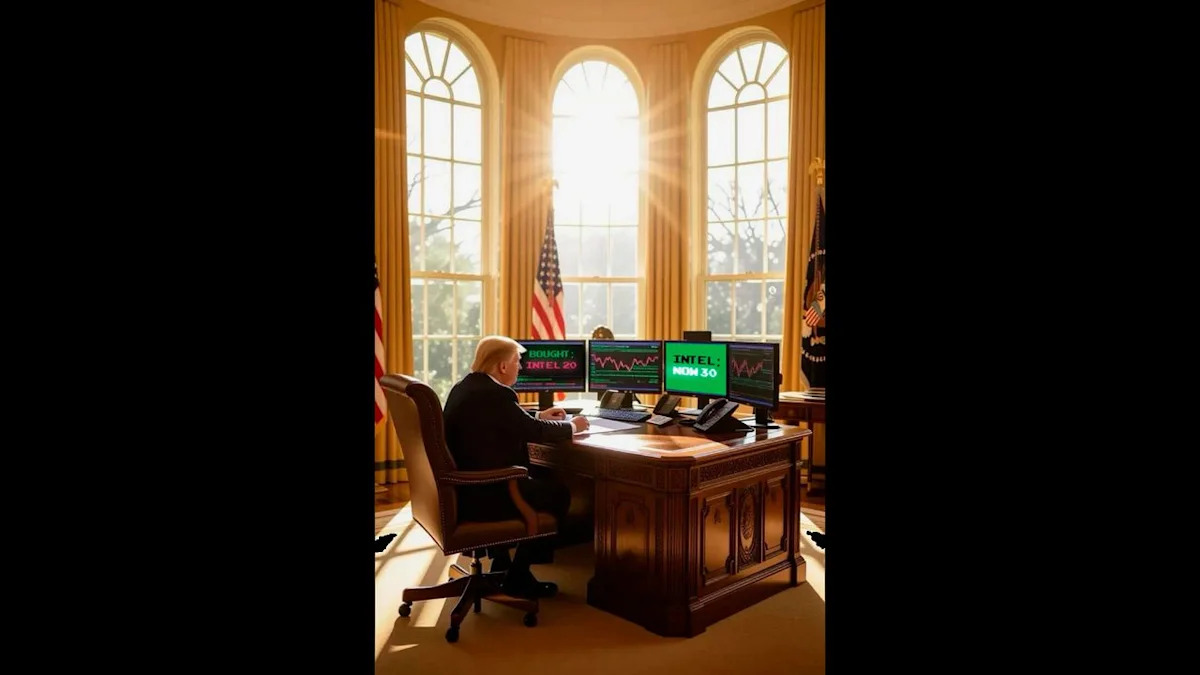
However, this visual is not a photograph of a real event. It is an artificial intelligence-generated fabrication.
The primary indicator of its falsity lies in the context of its creation and distribution.
The image was posted by President Trump himself, but it does not capture a genuine moment in time.
Instead, it serves as a digital illustration created using generative AI tools.
This distinction is critical for understanding the nature of the content.
It is not a record of an actual transaction or a physical presence on a trading floor.
The subject matter of the image—Trump trading Intel stock—is entirely constructed by the AI.
There is no evidence of a real-world counterpart to this specific scene.
The image relies on the viewer’s assumption that it represents a factual occurrence. In reality, it is a synthetic composition.
The fabrication is further highlighted by the disconnect between the visual and established industrial realities.
While the image suggests a direct, personal involvement in high-tech trading,
the actual production of the world’s best chips remains rooted in physical infrastructure.
Soil and land are the foundational elements where these critical components are manufactured.
This tangible reality contrasts sharply with the digital, ephemeral nature of the AI-generated image.
The image’s purpose appears to be illustrative rather than documentary.
It uses the recognizable figure of the President to create a narrative about market activity.
However, this narrative is not supported by photographic evidence.
The AI has generated a plausible-looking scene that does not correspond to any verified event.
In summary, the image is fabricated because it is an AI creation, not a photograph. It depicts a scenario that did not happen.
The visual elements are synthesized, not captured. The context of its posting confirms its artificial origin.
The image serves as a digital representation, not a factual record.
The disconnect between the AI-generated scene and the physical reality of chip manufacturing underscores its fabricated nature.
The image is a product of generative technology, not a documentation of real-world events.
Trump’s Stock‑Market Claims on Truth Social
On a recent Sunday, Donald Trump engaged in a prolonged posting spree on his social media platform, Truth Social.
According to reports, he spent more than ten hours uploading dozens of images that appeared to be generated by artificial intelligence.
This activity accompanied unverified claims regarding his financial performance, specifically concerning stock market investments.
The core of these posts centered on a bold assertion about wealth generation.
Trump stated, “I’ve made Hundreds of Billions of Dollars on Stocks, and many other type Holdings, for the U. S.
A., not myself, and all I do is get criticized by the Radical Left Dumocrats.” This quote highlights two primary elements of his messaging:
the magnitude of the alleged profits and the attribution of those gains to the United States rather than his personal fortune.
Key details from the evidence include:
- Platform: Truth Social.
- Timing: A specific Sunday, with posts spanning over ten hours.
- Content: Dozens of apparently AI-generated images.
- Claim: Making “hundreds of billions of dollars” on stocks and other holdings.
- Attribution: Profits claimed to be for the U.S.A., not himself.
- Political Context: Criticism directed at “Radical Left Dumocrats.”
It is important to note that these claims remain unverified.
The evidence provided does not include independent financial audits, stock transaction records,
or third-party confirmation of the alleged hundreds of billions in profits.
Furthermore, the specific nature of the “other type Holdings” mentioned is not detailed in the available text.
The visual component of the posts—described as apparently AI-generated images—served as the backdrop for these textual assertions,
but the images themselves do not provide financial data or proof of the claims made.
No additional context regarding market reactions, expert analysis,
or historical stock performance data is available in the assigned evidence.
The focus remains strictly on the content of the posts and the specific wording used by Trump on Truth Social.
Without corroborating financial documentation,
the assertion of generating hundreds of billions of dollars for the country remains a standalone claim within this digital communication.
Assessing the Credibility of Trump’s Claims
The credibility of President Trump’s recent stock market claims hinges on the nature of the visual evidence he presented.
According to reports from Tom’s Hardware, the President shared an image depicting himself trading Intel stock within the White House.
Crucially, this image was identified as AI-generated, meaning it is a synthetic creation rather than a photograph of an actual event.
The specific details embedded in this digital fabrication provide the only concrete data points for assessment.
The image illustrates a transaction involving Intel (INTC) shares.
The narrative presented in the graphic states that the imaginary shares were purchased at $20 and subsequently sold at $30.
This $10 gain per share is described as reflective of real-world price movements for the company’s stock.
When evaluating the validity of these claims, several factors must be considered:
- Synthetic Origin: The primary evidence is an AI-generated image, not a verified record of a trade.
- Imaginary Transaction: The purchase and sale described are explicitly labeled as imaginary within the context of the image.
- Price Alignment: The cited prices ($20 buy, $30 sell) align with actual historical market prices for Intel, lending a veneer of realism to the fabrication.
Because the source material is a generated image rather than a financial statement or official trade log,
the claim cannot be verified as a factual occurrence.
The alignment with real-world prices suggests the image was designed to mimic plausible market activity,
but it does not constitute proof of actual trading by the President.
Without additional documentation confirming a real transaction,
the claim remains an unverified assertion supported only by a synthetic visual.
The distinction between the illustrative nature of the AI image and actual financial activity is the central issue in assessing its credibility.
What This Means for Investors
The provided evidence offers limited direct insight into market implications,
focusing instead on a specific administrative claim regarding toll collection rights.
According to the source material,
an agency has officially stated that “The right to collect tolls has been recognized.” This declaration serves as the primary factual anchor for any subsequent analysis,
though the text does not elaborate on the financial magnitude, the specific entities involved,
or the immediate economic consequences of this recognition.
Investors should note the following confirmed details:
- Official Recognition: The agency has explicitly acknowledged the right to collect tolls.
- Timeframe: The statement references a period of “the next 60 days,” suggesting a relevant window for potential developments or enforcement actions related to this right.
- Source Context: This information originates from a publication dated June 17, 2026, titled “Slow Letter.”
Beyond these points, the evidence does not provide data on stock performance, investor sentiment, or broader market reactions.
There is no mention of specific price movements, trading volumes, or analyst forecasts tied to this announcement.
The connection between the toll collection right and broader economic indicators remains unconfirmed in the supplied text.
Consequently, any speculation regarding immediate gains or losses for investors would be unsupported by the current facts.
The absence of detailed financial metrics means that the direct impact on portfolio values cannot be quantified from this source alone.
The reference to the “next 60 days” implies a period of observation,
but the specific events or milestones expected during this timeframe are not described.
Without additional context regarding the scale of toll revenues or the regulatory environment,
the significance of this recognition remains ambiguous.
Investors relying solely on this information must acknowledge that the primary takeaway is the legal or administrative validation of toll collection rights,
rather than a clear signal of market direction.
Further clarification from the agency or related financial reports would be necessary to assess the true economic weight of this decision.